Our farmers

We know who grew it.

Most coffee is sold with a country on the bag. Ours comes with a name: these are the people we buy from, and what they grow.

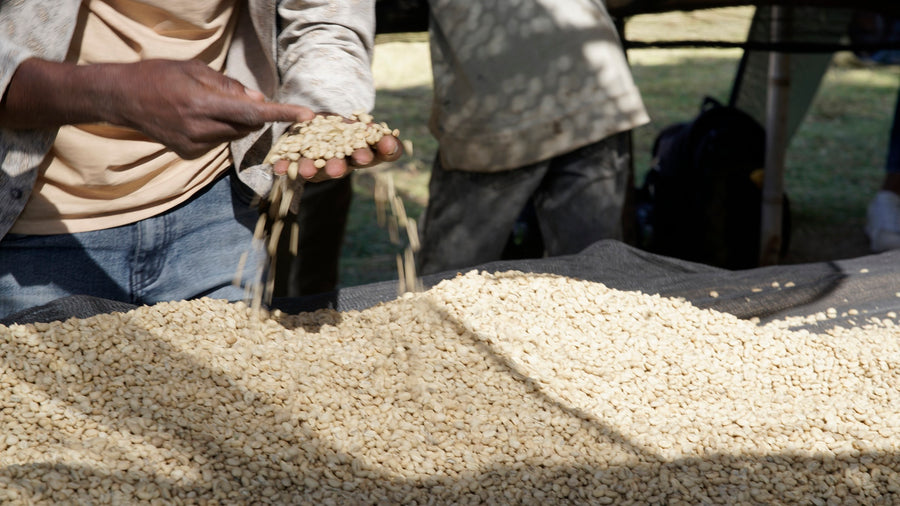
A farmer lets parchment coffee run through his hands over a drying bed

Teshale Heurioso

Bona QeQe, Sidama · 2,050 m
Natural, Grade 1

Teshale farms in Bona QeQe, a small highland corner of the Bona region in Sidama. He is 46 and works the land his family has farmed for generations, with his wife and their six children.

For six years he was treasurer of the local cooperative in Bona. In 2019 he exported coffee under his own name for the first time. He follows Heleph Coffee's protocol for picking and drying and produces about 100 bags a year, all Grade 1.

His coffee: Stone Fruit

Tsegab Ayele Tulu

Bona Zuria, Sidama · 1,900 m and up
Red honey, Grade 1

Tsegab was born and raised in Hawassa, the capital of Sidama, and came into coffee in 2011. His grandfather Tulu planted the family's first coffee in 1976 in Harbegona, today's Bona Zuria. His father Ayele took over part of the farms in 1986 and built washing stations.

When Ethiopia let producers sell directly to importers abroad, Tsegab founded Heleph Coffee in 2018 to do exactly that. He owns and runs it, and most of the farmers on this page sell through him.

His own lot is a red honey: the cherries are pulped, fermented under close control and dried slowly on shaded beds, which evens out the moisture in the bean. The farm is 8 hectares, with 15 permanent staff and 145 seasonal workers.

His coffee: Honeycomb

Ayele Tulu

Demeka Becha, Bona Zuria, Sidama · 2,200 m
Washed, Grade 1

Ayele, Tsegab's father, has grown coffee since the 1980s, when he inherited a piece of land from his own father. He is a father of three, and the cooperative holds his 5-hectare farm up as a model for how coffee should be grown and picked.

His site at Demeka Becha takes in cherries from the communities around it, Dilla Suke, Demeka, Gowacho, Becha and Bashiro Dale: close to 10,000 producers in all. Every delivery is weighed on the station's teal scale, floated to take out the light cherries and dried on raised beds for 14 to 21 days.

Meselech Tubie

Shentawene, Bensa, Sidama · 1,950–2,030 m

Meselech is a mother of five who farms 3.5 hectares in Bensa. The land was her father's; she has grown coffee on it since the 1990s.

She picks only ripe red cherries, by hand, and sorts them by hand again before they are dried in thin layers on raised beds for 15 to 22 days, turned regularly.

Selling her coffee under her own name earns her more for it, which she puts back into the farm.

Buze Beshu

Bensa Dembi, Sidama · 2,130 m
Washed, Grade 1

Buze and her husband have run their 4.5-hectare family farm in the village of Bensa Dembi for twenty years, raising five children on it. Fifteen people work there all year.

She oversees the processing herself: the cherries are picked ripe, floated in a tank to take out the unripe ones, pulped, fermented in water for 24 to 72 hours and dried in the sun for a few weeks.

Abebe Hewiso

Boreta Weyo, Bona Zuria, Sidama · 1,950–2,030 m
Natural

Abebe is 55, a father of eleven, and has grown coffee for twenty years on 3 hectares in Boreta Weyo.

In 2022 his coffee placed 9th in Ethiopia's Cup of Excellence with a score of 89.36, after earlier years in which he had entered without reaching the top 40.

He dries his cherries whole on raised beds, turning them regularly, before they are hulled at the mill.

Draft: written from the farmer profiles in the Drive folder. Dereje to confirm whose coffee is on sale now, and to add photos In the finished site this page is filled from the farmers kept in the Coffee Catalog, each with its lots on sale.