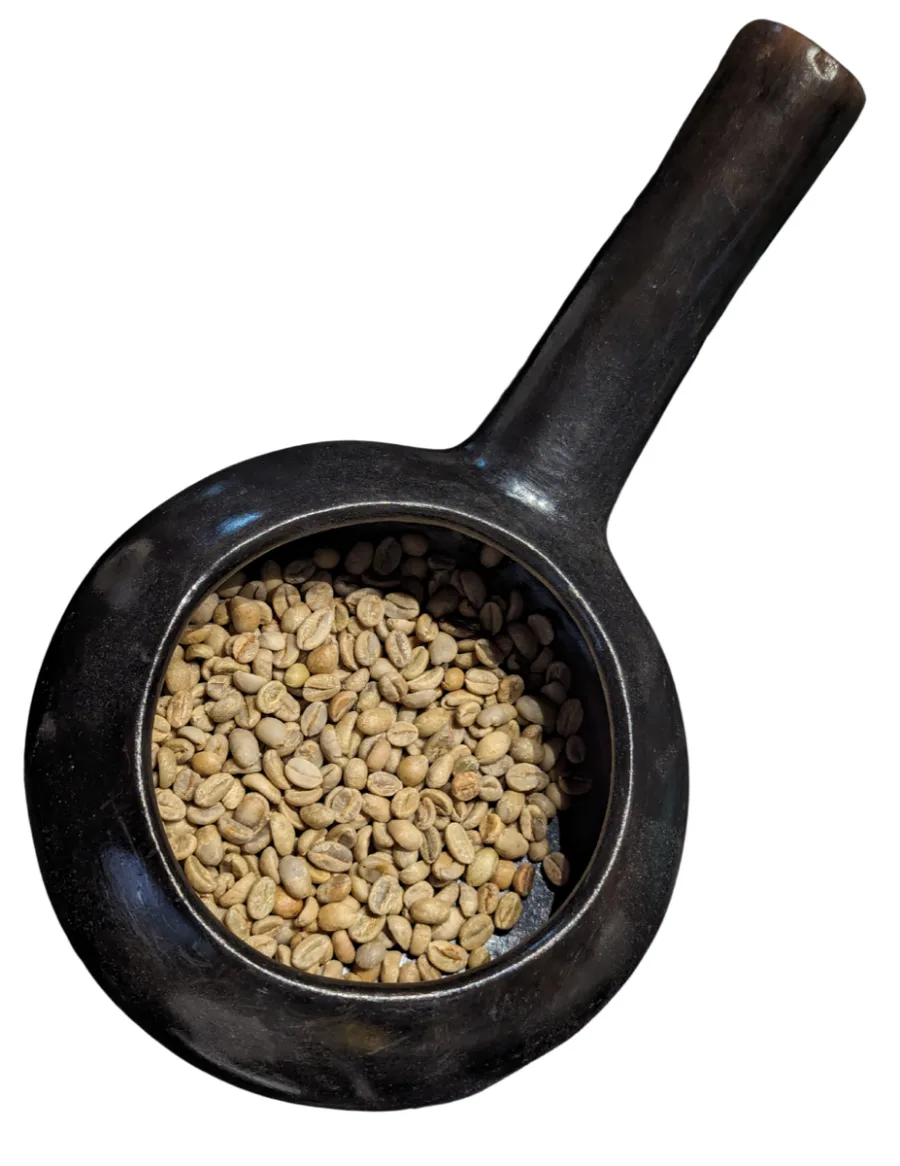
Roast your coffee the way it is roasted at home in Ethiopia.
A clay roaster with a long handle, made by hand in Addis Ababa by the women of Ensira Pottery, from the same clay as the jebena, Ethiopia’s coffee pot. It is the roaster of the Ethiopian coffee ceremony, and it turns green coffee into a fresh roast on your own stove in about ten minutes.
- Made of
- Clay, the same as a jebena, shaped and fired by hand
- Made by
- Ensira Pottery, a women’s cooperative in Addis Ababa
- Weight
- Under 1 kg. Each one is a little different in size and shape
- In the kit
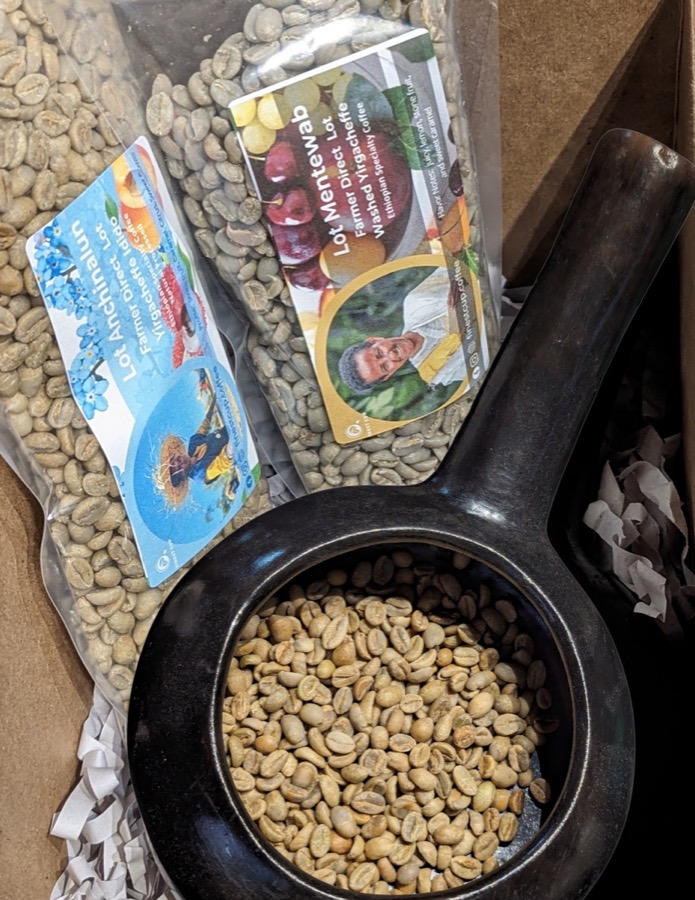
- The roaster and two 250 g bags of green Ethiopian coffee: one washed, one natural
- Each roast
- 150 to 250 g of green coffee
- Heat
- Any stove or fire: gas, electric or charcoal (not induction)
The kit is in our shop: see it at specialtycoffee.ca
The pan at the heart of the coffee ceremony
In Ethiopia, coffee is something you make for people. When guests come, the host sets out small cups on a tray, burns a little frankincense and starts from green beans. The beans are washed, then roasted in a long-handled pan over a small charcoal stove until they crackle and shine.
Before the coffee is ground, the host carries the roaster, still warm and full of freshly roasted beans, around the room, and each guest leans in to smell it. It is the first taste of the coffee to come, and a way of welcoming everyone. The beans are then pounded by hand in a wooden mortar, brewed in a clay pot called a jebena and poured in three rounds: abol, the first and strongest, then tona, then bereka, the blessing. A ceremony easily takes an hour, and nobody is in a hurry to leave.
This roaster is that pan, made for the same ceremony by the same hands that make the jebena.
The women of Ensira Pottery
Each roaster is made by Ensira Pottery, the Ensira Pottery Cooperative Association: around 300 women who make traditional Ethiopian pottery by hand in Gulele, in the north of Addis Ababa, on the former grounds of Ras Imru Haile Selassie.
Their workshop makes what an Ethiopian kitchen needs: jebena coffee pots, the small sini cups coffee is served in, bowls for shiro, storage pots and incense burners. The roaster is made from the same clay as their jebenas, shaped by hand without a mould and fired. That is why no two are quite the same size, and why each one weighs a little under a kilo.
Why roast in clay
A home roasting machine shuts the coffee away in a drum. In clay it is in front of you the whole time, as it is in Japan’s clay roaster, the hōroku, a close cousin of this one.
Even, gentle heat
Clay warms up slowly and holds its heat. The beans roast evenly and are slow to scorch, even when the heat is not quite steady.
You see, hear and smell it
No motor, no timer, no window. You watch the beans change colour, hear the first and second crack, and smell the roast change from grass to bread to caramel.
Your roast, your way
You decide when to stop: bright and light, or dark and chocolatey. Roast one coffee two ways and taste the difference.
Nothing but clay
No plug, no parts to break, no non-stick coating. Looked after, it lasts for years, and it darkens with every roast.
What happens in the roaster
About 150 g of beans on medium heat. The minutes are a guide: your stove and your coffee set the pace, and your eyes, ears and nose tell you where you are.
- Green0 – 3 min
The beans give off steam and smell of fresh grass and hay.
- Yellow3 – 5 min
The beans dry out and smell of toasted bread and grain.
- Light brown5 – 7 min
The colour deepens and the smell turns sweet. Thin skin, the chaff, starts to come off.
- First crack6 – 8 min
Loud pops, like popcorn, as the beans swell. Stop near the end of it for a light roast.
- Medium brown8 – 10 min
The pops fade; caramel and nuts. A minute or two after first crack is a medium roast.
- Second crack10 – 12 min
A quieter, quicker crackle, more smoke and a sheen of oil: a dark roast. Stop now, or it burns.
How to roast
You need the roaster, green coffee, a metal colander and an oven mitt.
- Give the smoke somewhere to go. Turn on the range hood or open a window, or roast outside. Roasting makes smoke, and the chaff flies.
- Weigh the coffee. About 150 g of green beans, a little under a cup. Pick out any broken or black beans and any small stones.
- Warm the roaster. Set the empty roaster on medium heat for 2 to 3 minutes, so the clay is warm right through.
- Keep the beans moving. Pour them in and keep the roaster moving in small circles the whole time, so the beans roll over the clay. A bean that sits still scorches on one side.
- Watch, listen, smell. Green to yellow to brown, then the pops of first crack after about 6 to 8 minutes.
- Stop when the colour is right. Light: at the end of first crack. Medium: a minute or two later. Dark: at the first snaps of second crack.
- Cool them at once. Tip the beans into the colander and toss them, or fan them, until you can hold them: hot beans keep roasting. Do it outside or over the sink, and the chaff blows away.
- Let them rest. Leave the coffee overnight in a jar with the lid on loosely, then grind and brew. It is at its best for about two weeks.
Watch a roast
Something to roast
The kit comes with two 250 g bags of green Ethiopian specialty coffee, enough for three roasts: one washed coffee, clean and bright, and one natural, dried in the cherry, fruity and sweet. Roast them side by side and you will taste what the processing does.
When they run out, our green coffee shop has the same farmers' coffees by the bag, from the lots we import ourselves.
Green coffee at specialtycoffee.caGood to know
How much coffee does one roast make?
Coffee loses about a sixth of its weight as it roasts, mostly water. 150 g of green coffee makes about 125 g roasted: around eight cups of pour-over.
What can I roast on?
Any heat: a gas stove, an electric stove with coils or a glass top, a camping burner, charcoal or a wood fire. The one exception is an induction stove, which only heats iron and steel pans, so clay stays cold on it.
Does it make smoke?
Some, and more the darker you roast, most of all at second crack. Use the range hood, open a window, or roast outside. Your home will smell of coffee for the rest of the day.
Does the handle get hot?
The long handle keeps your hand away from the heat, but clay holds its heat. Hold it with an oven mitt or a folded cloth, and never leave the roaster on the stove unattended.
How do I look after it?
Let it cool by itself on a dry board or a trivet. Never pour cold water into a hot roaster or set it down on a cold, wet surface: a sudden change of temperature can crack clay. Once it is cool, wipe it out or rinse it with warm water, without soap and not in the dishwasher, and let it dry fully before you put it away. It darkens as you use it; that is how it should be.
Is it a good gift?
For anyone who loves coffee or cooking, yes: it is a gift and an afternoon's project in one. See all our gifts.
The roaster and two bags of green coffee
. Ships as soon as the next business day.
See it in our shop