More than a region on a bag.
Most coffee is sold on its tasting notes and its map: a region, an altitude, a list of flavours. Those things matter. But they leave out the people who made the coffee possible.
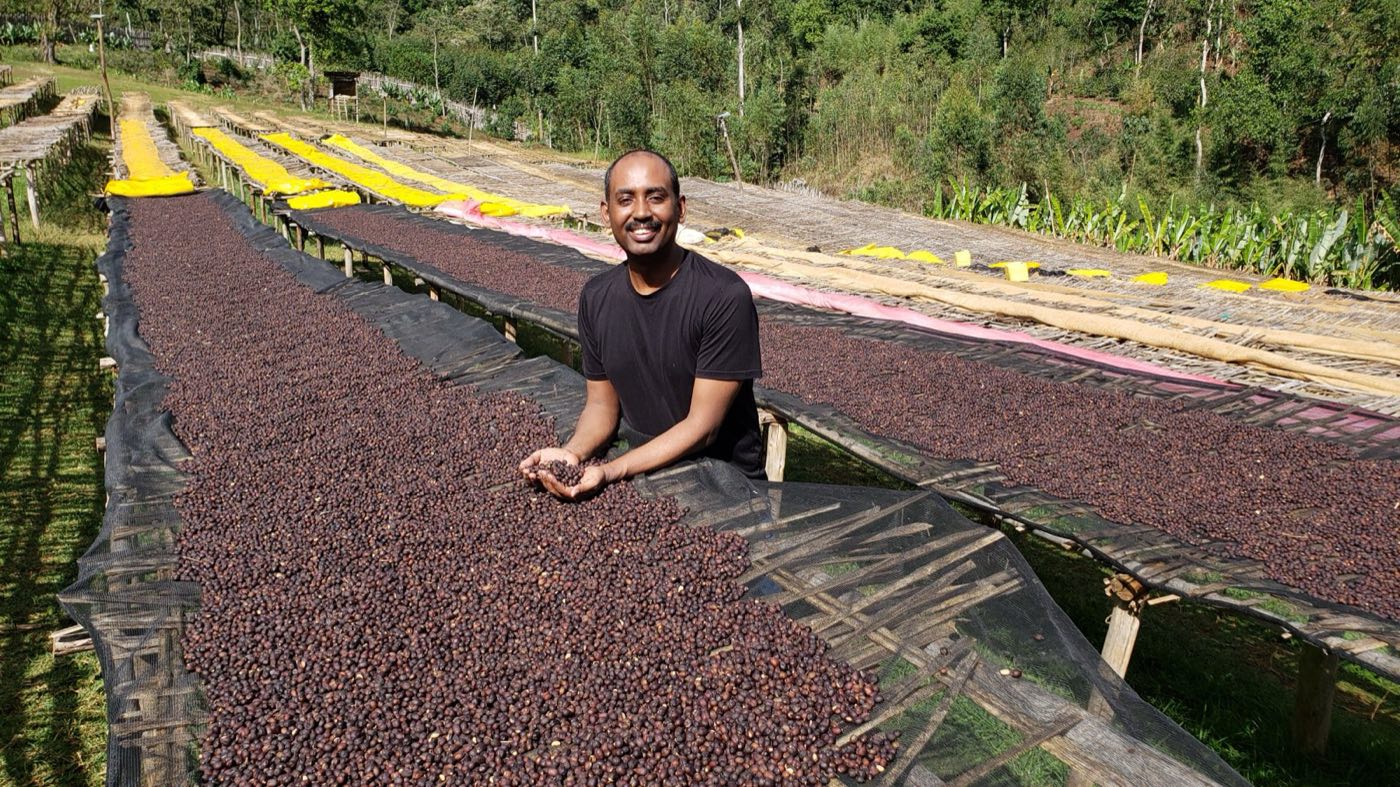
Dereje at the drying beds, Ethiopia, February 2020.
Coffee began in Ethiopia. So did we.
Every arabica coffee tree on earth traces its roots back to Ethiopia. Centuries ago a small handful of seeds were carried from these highlands to Yemen, and from there to India, to Java, and eventually across the Americas. Almost all the arabica grown in the world today descends from that handful, but what stayed behind is far richer. Ethiopia is home to thousands of heirloom varieties found nowhere else, still growing in the conditions coffee evolved for, and they taste like nowhere else because there is nowhere else.
Finest Cup is Ethiopian-owned. In Ethiopia, coffee is more than a crop. It is how the day starts, how guests are welcomed, and how millions of families earn their living. We wanted the people who drink our coffee to see past the flavour notes to that.
The people behind every bag
So we tell you who grew it. Not only the farmers, but the pickers who choose the ripe cherries by hand, the sorters at the washing stations, the people who turn the drying beds for weeks, and the exporters who get it all to port. Their work is what you taste, and where we can, their names are on the bag.
Farmers we call friends
As Ethiopians, we’re proud to bring you this coffee from its origin. We buy from community farmers who have invited us into their homes and shared a meal with us. These are people we call friends, not a sourcing story we read in a report.
Fewer hands in between
Coffee usually passes through several brokers between the farm and the roaster, and each one takes a share. Wherever we can, we skip them: we work directly with farmers, washing stations and exporters such as Heleph Coffee, so more of what the coffee earns stays with the people who grow and process it.
Small lots, chosen by taste
That relationship is what lets us be selective. We take small lots rather than containers, choosing coffees for what they actually taste like rather than what’s easy to move. It also means we can tell you what’s in each bag, and where there is one name to print, it’s on the front.
Finding a market for their coffee
Buying for ourselves is only part of it. We import coffee from the producers we know and connect them with roasters who care about the same things, through our green coffee shop at specialtycoffee.ca. The more roasters buy this way, the more these farmers can sell on their own terms.
Roasted and served in Surrey
We roast in small batches in Surrey, BC, and since 2019 we’ve served the coffee at our café in the Atrium Centre on 160 Street, as espresso, as a pour-over, or the traditional Ethiopian way.
When you buy our coffee, you become part of that chain: sourced from smallholder farmers, roasted locally and sold to you direct, so more of what you pay reaches the people who grew it.
The Legend of Kaldi
Long ago, in a time before anyone kept records, an Ethiopian goatherd named Kaldi found his goats dancing around a tree, stripping it of bright red cherries. He tried a few himself and felt the same strange spark, so he carried a handful down to the monastery.
But the monks wanted nothing to do with these cherries, and tossed them into the fire they were gathered around. Then an aroma rose from the embers, so rich it stopped them where they stood. They raked the beans from the coals, ground them, and brewed the very first cup of coffee. What followed was a clarity none of them expected: scripture and chanting through the night, minds sharper than they had ever been at that hour.
Twelve centuries later, coffee still does the same thing.